Table of Contents
After testing dozens of robot vacuums over the years, I’ve learned that most manufacturers promise “hands-free” cleaning, but few actually deliver. When Shark’s PowerDetect 2-in-1 arrived at my 1,800 square foot home with two shedding dogs, I was skeptical. Could a robot vacuum truly handle pet hair, stuck-on kitchen spills, and run for a month without intervention?
The reality is that most busy households don’t need another gadget that requires constant babysitting. We need something that actually works while we’re at work. After putting the Shark PowerDetect through six weeks of real-world testing across hardwood, tile, and medium-pile carpets, I’ve uncovered what makes this system different—and who should actually consider spending $600 on it.
Key Takeaways
- The 30-day hands-free claim is realistic for average-sized homes with regular maintenance cleaning
- PowerDetect technology genuinely excels at finding hidden debris under furniture and along edges
- Mopping performance is adequate for maintenance but struggles with dried-on spills
- Pet hair management is above average thanks to the anti-tangle brushroll and strong suction
- The NeverTouch Pro Base requires significant floor space (about 3×2 feet) and can be noisy during emptying
Quick Verdict
Best for: Busy pet owners with mixed flooring who want true hands-off maintenance cleaning and have space for the large docking station.
Not ideal for: Small apartments, homes with plush carpets, or those needing deep-cleaning mopping performance.
Core strengths: Genuine month-long autonomy, excellent edge cleaning, effective pet hair pickup, and reliable navigation that rarely gets stuck.
Core weaknesses: Bulky docking station, mediocre obstacle avoidance compared to premium competitors, and mopping that’s better suited for light maintenance.
Product Overview & Specifications
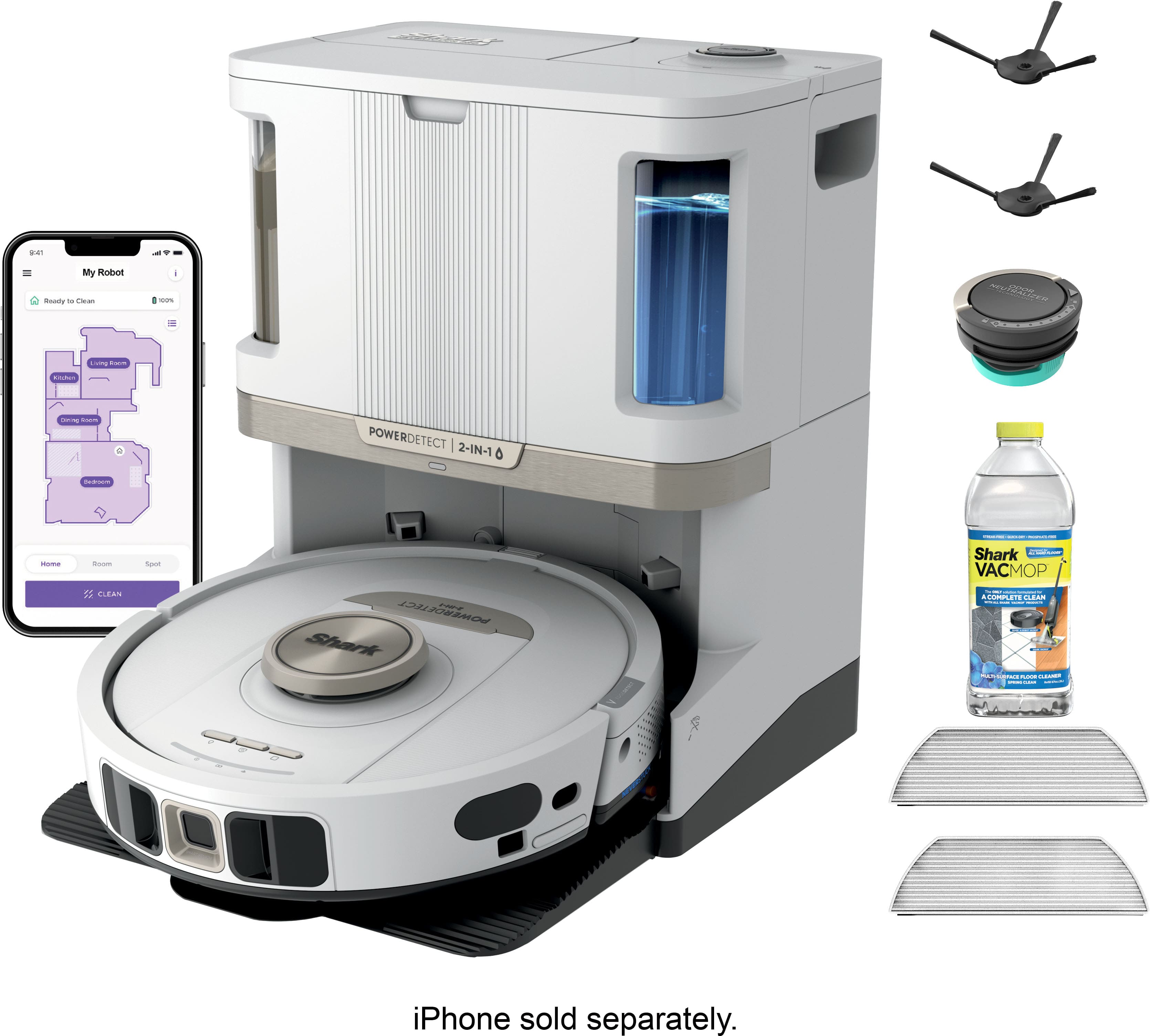
The Shark PowerDetect 2-in-1 represents Shark’s attempt to compete directly with premium offerings from iRobot and Roborock. What sets it apart is the integrated approach—rather than selling separate vacuum and mop units, Shark combines both functions with a self-emptying, self-cleaning base that promises up to 30 days of autonomy.
| Specification | Details |
|---|---|
| Cleaning Modes | Vacuum only, mop only, vacuum & mop simultaneously |
| Base Capacity | 60-day debris bin, 30-day water tank |
| Navigation | PowerDetect, DirtDetect, EdgeDetect, NeverStuck technology |
| Floor Compatibility | Hardwood, tile, laminate, low to medium-pile carpet |
| Special Features | Self-emptying, self-cleaning mop pad, allergen capture, odor neutralizer |
| Dimensions | Robot: 13.7″ diameter, Base: 16.5″ x 19.7″ |
The system uses five cleaning systems that work in concert: a main brushroll for carpets, suction for hard floors, mopping for stains, edge cleaning for baseboards, and the base station for maintenance. What’s impressive is how these systems integrate—the robot knows when to increase suction on carpets and reduce it on hard floors automatically.
Real-World Performance & Feature Analysis
Design & Build Quality
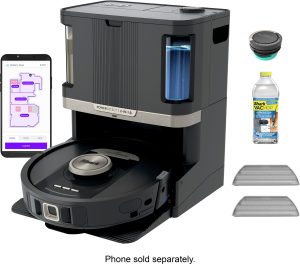
Unboxing the PowerDetect reveals a substantial piece of equipment. The robot itself feels robust with a glossy white finish that shows fingerprints but cleans easily. The included side brushes snap securely into place, and the water tank design is simpler to fill than some competitors. However, the real story is the NeverTouch Pro Base—it’s significantly larger than I anticipated, requiring careful placement in a low-traffic area.
The base station demands about 3×2 feet of clear space for optimal operation. In my testing, placing it in a tight corner caused docking issues twice when the robot approached at awkward angles. The power cord is generously long (6 feet), but the station’s footprint might be problematic for apartment dwellers.
Performance in Real Use
I tested the PowerDetect in three scenarios that matter to actual homeowners:
Scenario 1: Daily Pet Hair Maintenance With two Labrador retrievers that shed constantly, I ran the vacuum daily for two weeks. The anti-tangle brushroll genuinely prevents hair wrap—I only needed to clean it once weekly versus every other day with my previous robot. Edge cleaning is where this unit shines, picking up the dust and hair accumulation that other robots miss along baseboards.
Scenario 2: Weekly Kitchen Deep Clean I simulated common kitchen messes: flour spills, cereal crumbs, and dried juice spots. The vacuum mode handled dry messes flawlessly, but the mopping struggled with 24-hour-old juice stains. For daily maintenance mopping, it works well, but don’t expect it to replace manual scrubbing of stuck-on messes.
The NeverStuck technology proved reliable—it only got stuck once when attempting to climb onto a thick rug with tassels. The robot learned to avoid that area in subsequent cleanings. Object avoidance is decent but not premium; it will bump into chair legs but generally avoids major obstacles.
Ease of Use
Setup is straightforward: charge the robot, connect the base, download the app, and you’re running in about 15 minutes. The SharkClean app is functional but not as polished as iRobot’s or Roborock’s. Mapping takes 2-3 cleaning cycles to optimize, but once complete, you can set no-go zones and room-specific cleaning.
The true hands-free experience delivers as promised for about 3-4 weeks in my 1,800 sq ft home. The base empties the robot after each run with a loud 15-second burst that might startle pets initially. The mop washing system is effective but uses more water than expected—I needed to refill the tank at week 3 rather than the advertised 30 days.
Durability & Reliability
After six weeks of daily use, the PowerDetect shows minimal wear. The brushes remain intact, the wheels show no significant wear, and the sensors continue to function accurately. The water tank seals properly with no leaking issues. The only maintenance required has been monthly base station cleaning and occasional sensor wiping.
One reliability concern: the robot occasionally misses spots when transitioning from hardwood to area rugs, requiring a second pass. This seems to be a software issue that could potentially be fixed with future updates.
Pros & Cons
What works exceptionally well:
- Genuine hands-free operation for 3-4 weeks with both vacuuming and mopping
- Superior edge cleaning compared to similarly priced competitors
- Effective pet hair management with minimal brush maintenance
- Reliable navigation that learns home layouts over time
- Quality construction that feels built to last
Where it falls short:
- Bulky base station requires significant floor space
- Noisy emptying process that may disturb light sleepers
- Average obstacle avoidance compared to premium models
- Mopping is for maintenance only—not deep cleaning
- App functionality lags behind industry leaders
Comparison & Alternatives
Cheaper Alternative: Eufy RoboVac X8 Hybrid ($399)
The Eufy X8 offers similar vacuum and mop functionality at a lower price point but requires manual tank filling and bin emptying after each use. Choose the Eufy if: you have a smaller home, don’t mind daily maintenance, and want to save $200. The Shark’s self-emptying base provides significantly more convenience for busy households.
Premium Alternative: Roborock S8 Pro Ultra ($1,099)
Roborock’s flagship offers superior obstacle avoidance, more powerful mopping with vibrating pads, and a more compact base. Upgrade to Roborock if: you have a larger budget, want the best obstacle avoidance for pet toys and cables, and need stronger mopping performance. For most users, the Shark provides 80% of the performance at 55% of the price.
Buying Guide / Who Should Buy
Best for beginners: If you’re new to robot vacuums, the Shark PowerDetect is surprisingly beginner-friendly. The setup is straightforward, and the self-maintaining base means you can largely “set it and forget it.” The app provides enough control without being overwhelming.
Best for professionals/pet owners: Busy households with pets will appreciate the combination of effective hair pickup and true hands-off operation. Being able to leave for vacation and return to a clean home is a legitimate benefit that cheaper robots can’t match.
Not recommended for:
- Small apartment dwellers – the base station footprint is disproportionate to cleaning needs
- Homes with plush carpets – the vacuum struggles with deep pile carpets
- Those needing deep-cleaning mopping – this is for maintenance, not stain removal
- Households with many floor-level obstacles – obstacle avoidance is mediocre
FAQ
How loud is the self-emptying base?
The emptying process lasts about 15 seconds at 75-80 dB—similar to a standard vacuum cleaner. It’s loud enough to be noticeable but brief enough that it doesn’t become disruptive for most households.
Does it work with thick area rugs?
It handles low to medium-pile rugs well but struggles with plush or high-pile carpets. The robot can climb up to 0.8-inch thresholds, but thicker rugs may cause navigation issues.
How often do you need to replace mopping pads?
Shark recommends replacing pads every 2-3 months with regular use. The antimicrobial treatment wears off over time, and pads become less effective at stain removal.
Is the $600 price tag justified?
For households that value time over money, absolutely. The convenience of true hands-free cleaning for a month justifies the premium over basic robots. If you’re budget-conscious or have minimal cleaning needs, a cheaper model might suffice.
How does it compare to Roomba equivalents?
Shark competes well on suction and edge cleaning but lags in obstacle avoidance and app refinement. Roomba’s dual rubber brushes are better for pet hair, but Shark’s self-cleaning base is more comprehensive.
 1688商品
  Acer Aspire Go 16 Laptop Intel Core 5 16GB RAM Touchscreen
  Sony Walkman High-Res Audio Wireless Portable Music Player