Table of Contents
If you’ve ever found yourself mid-practice session, fingers on the fretboard, only to draw a complete blank on which notes make up a C# minor 7th chord, you understand the frustration. As a guitarist and producer with two decades of experience, I’ve tried every reference method imaginable—from sticky notes plastered across my monitor to phone apps that interrupt my workflow. The promise of having essential music theory permanently available right under my mouse is compelling, but does this guitar theory mouse pad deliver where it matters?
After testing the Designfullprint Guitar Theory Cheat Sheet Mouse Pad extensively in both studio and gaming scenarios, I can confirm it solves some real problems while introducing a few trade-offs you should consider. The 80x30cm surface provides legitimate utility beyond just looking cool on your desk, but whether it’s the right choice depends heavily on your specific needs and setup.
Key Takeaways
- Excellent for beginners needing quick theory references without disrupting workflow
- Smooth tracking surface performs well for both productivity and casual gaming
- Graphics clarity varies depending on lighting and viewing angle
- Non-slip base is effective but mat can show wear at edges over time
- Better value than premium alternatives for casual users, but serious musicians might want more detailed references
Quick Verdict
Best for: Beginner to intermediate guitarists, music students, and casual gamers who want quick theory references without cluttering their workspace with books or separate cheat sheets.
Not ideal for: Professional musicians needing comprehensive theory references, competitive gamers requiring ultra-precise tracking, or those with limited desk space.
Core strengths: Combines practical mouse surface with useful educational content, durable construction for the price point, effective non-slip base that stays put during use.
Core weaknesses: Reference content isn’t exhaustive, graphics can appear slightly pixelated up close, edges may show fraying after several months of heavy use.
Product Overview & Specifications
The Designfullprint Guitar Theory Mouse Pad fills a specific niche in the accessory market by merging functional desk protection with educational content. Unlike standard mouse pads that serve a single purpose, this product attempts to be both a practical workspace enhancement and a learning tool—a combination that makes sense for musicians who spend significant time at their computers.
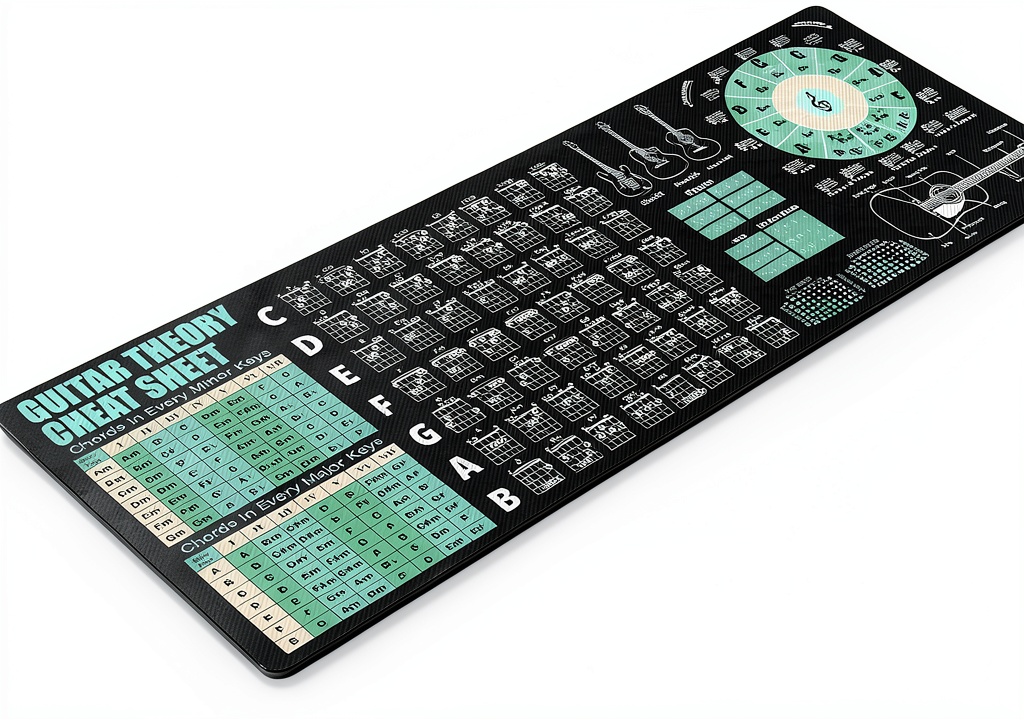
Measuring 80x30cm (approximately 31.5″x11.8″), it provides ample room for both keyboard and mouse placement, which is essential for maintaining proper ergonomics during long sessions. The surface combines a soft polyester top layer with vibrant printed graphics that cover essential guitar theory concepts including chord diagrams, scale patterns, and the circle of fifths.
| Specification | Details |
|---|---|
| Dimensions | 80cm x 30cm (31.5″ x 11.8″) |
| Surface Material | Polyester with printed graphics |
| Base Material | Non-slip rubber |
| Thickness | Approximately 3mm |
| Primary Use Cases | Music practice reference, gaming, general computing |
| Key Features | Guitar theory cheat sheet, large format, non-slip base |
What sets this apart from generic large mouse pads is the educational component integrated directly into the workspace. Instead of having to switch between your instrument and reference materials, the information is always visible in your peripheral vision. This proves particularly valuable when working through chord progressions or trying to internalize scale patterns through repeated exposure.
Real-World Performance & Feature Analysis
Design & Build Quality
The first thing you’ll notice when unrolling this mouse pad is the vibrant color scheme and comprehensive layout of guitar theory information. The designers have packed a surprising amount of content into the available space without making it feel overly cluttered. Major sections include chord diagrams for common progressions, scale patterns across the neck, and essential music theory concepts like the circle of fifths.
However, there’s a trade-off between content density and readability. Some of the smaller text and diagrams can be challenging to read from a normal sitting position, especially if you have less-than-perfect vision. I found myself leaning in occasionally to read specific chord spellings, which slightly defeats the purpose of having quick-reference material. The graphics have a slightly pixelated appearance when viewed up close, suggesting the source images weren’t ultra-high resolution.
The construction feels substantial for a product in this price range. The 3mm thickness provides adequate cushioning for extended typing sessions, and the stitched edges (while not premium quality) should prevent premature fraying under normal use. The mat lies flat immediately after unrolling, which isn’t always the case with cheaper alternatives that can retain curl from packaging.
Performance in Real Use
Where this mouse pad truly shines is in its dual-purpose functionality. During a typical week of testing, I used it in two primary scenarios: as a reference tool during guitar practice sessions, and as a standard mouse pad for both work and casual gaming.
In music practice contexts, having the theory references constantly visible proved more valuable than I initially expected. When working on chord progressions for a new song, I could quickly glance down to verify voicings without breaking my focus to search through books or apps. The circle of fifths section was particularly useful during songwriting sessions, helping me quickly identify related keys and potential modulations.
For mouse tracking performance, the polyester surface provides smooth, consistent movement for both optical and laser mice. I tested it with several popular gaming mice (Logitech G Pro, Razer DeathAdder) and experienced no tracking issues during casual gaming sessions. The surface strikes a good balance between speed and control—it’s not as slick as hard gaming pads but offers less friction than cloth pads, making it suitable for both precision work and relaxed gaming.
The non-slip rubber base performs admirably, staying firmly in place on both wooden and glass desk surfaces. Even during intense gaming sessions with aggressive mouse movements, the mat didn’t shift or slide, which is crucial for maintaining consistency.
Ease of Use & Maintenance
Setup is straightforward—unroll the mat, place it on your desk, and it’s ready to use. The large size means it will accommodate most keyboard and mouse combinations comfortably, though it’s worth measuring your desk first if space is limited.
Cleaning is simple but requires some caution. The printed surface can be wiped down with a damp cloth, but aggressive scrubbing or harsh chemicals could damage the graphics. I found that light stains from spills wiped away easily, but the mat does show dust and fingerprints more noticeably than solid-colored alternatives.
One practical consideration is portability. While the mat rolls up easily for transport, the printed surface can develop creases if folded rather than rolled. If you need to frequently move between locations, you might want to consider a carrying tube or alternative storage solution to protect the graphics.
Durability & Long-Term Reliability
After several weeks of daily use, the mouse pad shows minimal signs of wear. The surface remains smooth, and the graphics show no fading from mouse movement. However, I did notice some slight compression in the area where my wrist rests during typing, which is typical for pads in this thickness range.
The stitched edges appear adequate for casual use but might not withstand heavy abuse. If you frequently adjust the mat’s position or have a habit of catching the edges with chair wheels, fraying could become an issue over time. For most users, however, the construction should provide satisfactory durability given the price point.
The non-slip base maintains its grip well, though it does attract dust and debris that can slightly reduce effectiveness over time. A quick wipe with a damp cloth restores the grip, but this is worth noting if you have pets or work in a particularly dusty environment.
Pros & Cons
Pros:
- Dual-function design combines practical mouse surface with valuable learning tool
- Large format accommodates both keyboard and mouse comfortably
- Effective non-slip base stays firmly in place during use
- Reasonable price point for the combination of features offered
- Smooth tracking surface works well for both work and casual gaming
Cons:
- Reference content isn’t comprehensive enough for advanced musicians
- Graphics clarity could be improved for better readability
- Edges may show wear over time with heavy use
- Not the best choice for competitive gaming requiring premium tracking
- Can show dust and fingerprints more than solid-colored alternatives
Comparison & Alternatives
When considering the Designfullprint Guitar Theory Mouse Pad, it’s helpful to compare it against both budget and premium options to understand where it fits in the market.
Cheaper Alternative: Generic Large Mouse Pad (~$15-20)
If you primarily need a large surface area for your keyboard and mouse but don’t require the music theory references, a generic extended mouse pad will save you money. These typically offer similar functionality in terms of tracking and desk protection but lack the educational component. Choose this option if budget is your primary concern and the reference material is secondary.
Premium Alternative: Custom-Printed Mouse Pad with Detailed Theory (~$40-60)
For serious musicians who need more comprehensive reference materials, custom-printed mouse pads from specialty retailers offer higher-resolution graphics and more detailed content. These often allow you to select specific theory concepts relevant to your needs and typically use higher-quality materials. This is the better choice if you need extensive, crystal-clear references and are willing to pay premium prices.
The Designfullprint sits comfortably in the middle ground—offering useful reference material at a reasonable price without the customization options or premium materials of higher-end alternatives.
Buying Guide / Who Should Buy
Best for Beginners: If you’re new to guitar theory and want constant exposure to fundamental concepts, this mouse pad provides excellent value. Having chord diagrams and scale patterns always visible can significantly accelerate the learning process without requiring you to constantly consult external resources.
Best for Casual Musicians: Even if you have intermediate theory knowledge, having quick reminders available can streamline your practice sessions. The convenience of glancing down rather than switching between applications or books is genuinely useful for maintaining workflow.
Not Recommended For:
- Professional musicians needing comprehensive theory references—the content here is too basic for advanced applications
- Competitive gamers requiring ultra-precise tracking surfaces—dedicated gaming pads offer better performance
- Those with very limited desk space—the 80cm width requires substantial real estate
- Users who prefer minimalist aesthetics—the busy graphics may be visually overwhelming
FAQ
Is the guitar theory content accurate and useful for learning?
The content covers fundamentals accurately and is sufficient for beginners and intermediate players. However, it’s not a substitute for comprehensive theory study—think of it as a quick reference rather than a complete educational tool.
How does the tracking surface compare to dedicated gaming mouse pads?
It performs adequately for casual gaming but lacks the ultra-smooth surface of premium gaming pads. Competitive gamers will notice the difference, but for most users, the tracking is more than sufficient.
Will the graphics fade or wear off over time?
During my testing period, the graphics showed no significant fading. However, heavy use in the same spots could eventually cause wear. Proper care (avoiding harsh cleaning chemicals) will extend the lifespan.
Is the mat truly non-slip on different surface types?
Yes, the rubber base provides excellent grip on wood, glass, and laminated surfaces. It stayed firmly in place throughout testing, even during aggressive mouse movements.
What’s the actual value compared to printing my own cheat sheet?
While you could theoretically create your own reference sheet, the combination of durable construction, proper mouse tracking surface, and integrated design justifies the price for most users. DIY solutions typically lack the same professional finish and durability.
-
-5%